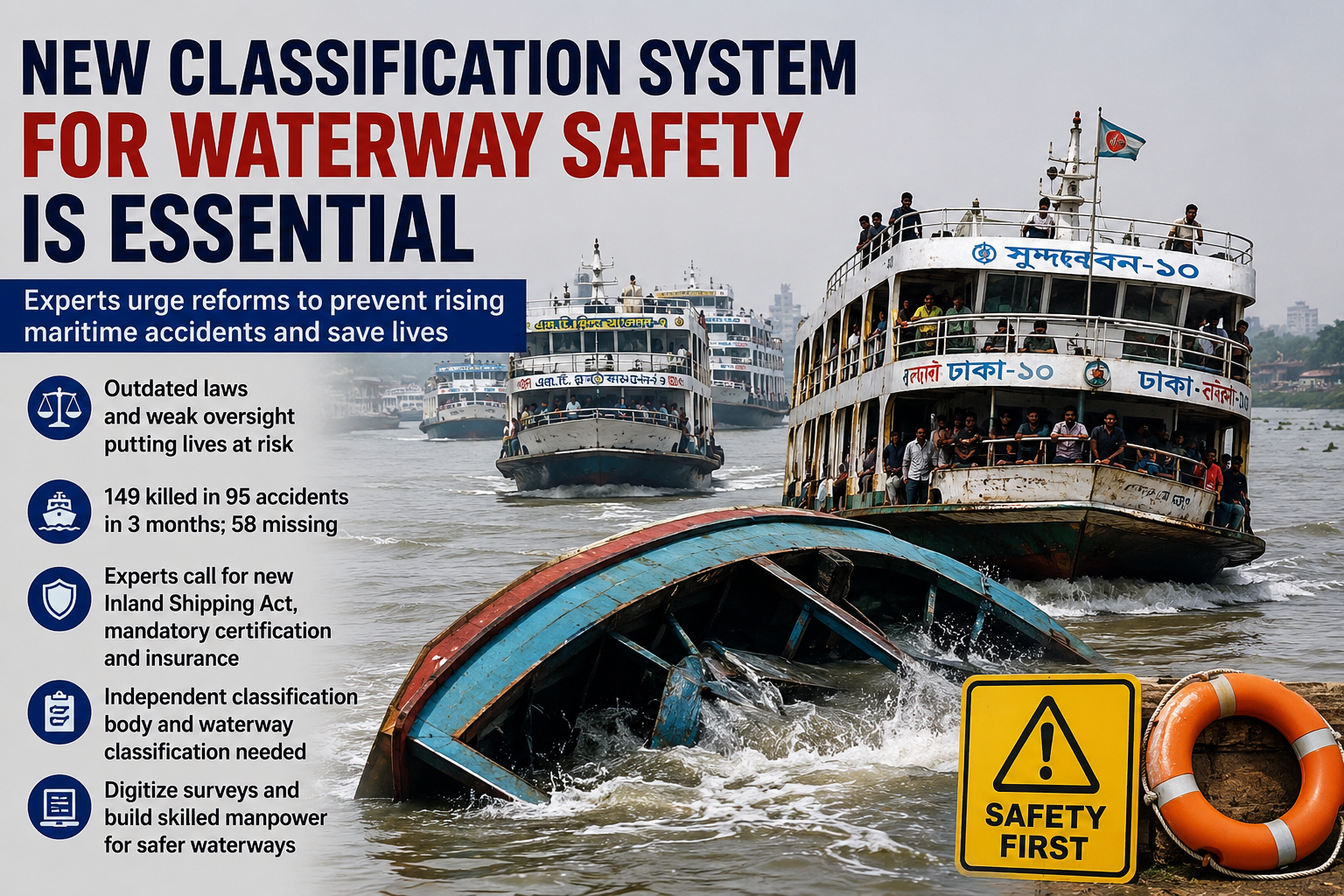
Dhaka: Bangladesh\'s inland waterways, often described as the country\'s economic lifeline, are witnessing a growing safety crisis, with experts calling for urgent reforms to modernize vessel regulation and establish a national classification system similar to those used internationally.
According to a recent survey by the Green Club of Bangladesh and the National Committee to Protect Shipping, Roads and Railways, at least 149 people were killed in 95 shipping accidents across inland waterways and coastal areas over the past three months. If the 58 people still missing are presumed dead, the death toll rises to 207.
Maritime safety experts attribute the increasing number of accidents to outdated legislation, weak enforcement, and the absence of an independent ship classification authority responsible for ensuring vessel safety standards.
Outdated Legal Framework
Bangladesh currently regulates vessels under two separate legal frameworks. International-going vessels operate under the Merchant Shipping Ordinance (MSO), which requires internationally recognized class certification. However, domestic inland vessels are governed by the Inland Shipping Ordinance (ISO) 1976, which does not require such certification.
Although both categories of vessels navigate the same waterways and transport passengers under similar commercial conditions, inland vessels rely only on survey certificates issued by the Department of Shipping (DOS). Experts argue that these certificates do not meet the rigorous safety standards maintained by international classification societies.
A study by Bangladesh Maritime University found that the Inland Shipping Ordinance (ISO) 1976 contains significant shortcomings in at least nine critical safety areas compared with international classification standards followed by organizations such as DNV, Bureau Veritas, and ABS. The study also identified these regulatory weaknesses as contributing factors in the 2021 MV Amanat Shah ferry accident.
Lessons from China
Experts point to China as a successful example of inland waterway regulation. Inland vessels in China are certified under the ZC or CS classification system operated by the China Classification Society (CCS).
China has developed dedicated technical standards for domestic vessels and classified its inland waterways into Classes A, B, and C, with separate operational requirements for each category. The system has significantly improved vessel safety, quality, and regulatory oversight.
Key Reform Recommendations
Maritime specialists have proposed several measures to strengthen Bangladesh\'s inland shipping sector:
-
Enact a modern Inland Shipping Act to replace the Inland Shipping Ordinance (ISO) 1976 and make HULL class certification mandatory for all inland vessels.
-
Establish an independent national classification organization, such as a Bangladesh Inland Ship Class (BISC), to certify vessels, while the Department of Shipping remains the regulatory authority.
-
Introduce a nationwide waterway classification system based on depth, navigability, and operational suitability.
-
Make insurance coverage compulsory for every registered vessel.
-
Strengthen the capacity of marine engineers, naval architects, and surveyors through specialized training and professional development.
-
Digitize vessel surveys and certification records to improve transparency, accountability, and regulatory oversight.
Urgent Need for Reform
Bangladesh recorded 127 maritime accidents claiming 158 lives last year, underscoring the need for immediate reforms in the country\'s maritime safety framework.
Experts believe that adopting a modern vessel classification system similar to China\'s would significantly reduce accidents and save lives. They stress that meaningful legal reform, institutional independence, and stronger enforcement are essential if Bangladesh is to build a safer and more reliable inland water transport system.


Comments (0)
No comments yet. Be the first to comment!